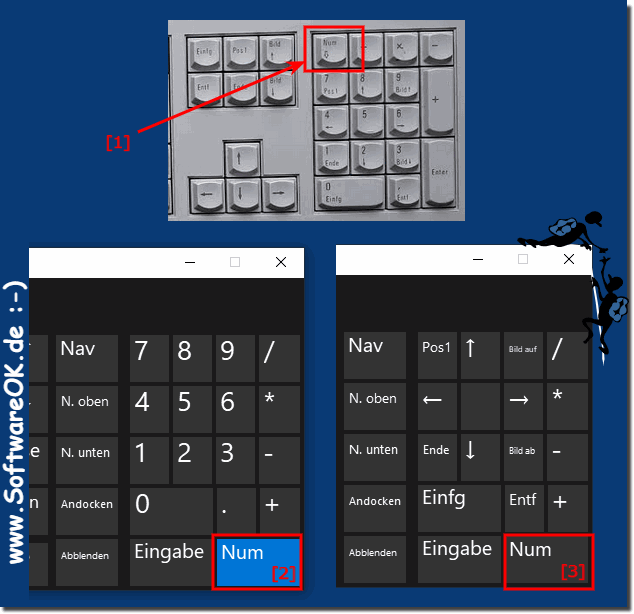
Num Lock, short for "combination lock", is a function of PC keyboards from the first IBM PC to save space on the keyboard!The keys on the numeric keypad have a dual role as numeric keys and cursor keys. To switch modes between them! Here is an example of a typical position of the numeric keypad and the Num-Lock function on a desktop keyboard and in the on-screen keyboard under Windows! ( ... see Image-1 Point 1 to 3 ) When the Num key is activated, the numeric keypad on a desktop PC works like a keyboard with numbers and symbols such as: *, /, +. to perform math operations. When the Num Lock key is deactivated, the keyboard is registered as cursor keys, such as the up and down arrows, and some editing keys, such as Home and Insert. 1. 📜 History of the Num Lock key 2. ✅ Advantages of the Num Lock key 3. ❌ Disadvantages of the Num Lock key 4. ⌨️ Is Num Lock still relevant? 5. 🔮 Future of the Num Lock key 6. 📌 Quick summary (to take away)
1.) 📜 History of the Num Lock keyThe Num Lock key originated in the early 1980s with the introduction of the IBM PC/AT keyboard (84 keys). At that time, keyboard space was at a premium, and the goal was to combine cursor movement (arrow keys) with a separate numeric keypad. The solution: The right-hand key block was given a dual function, switchable with Num Lock. In the 1990s, the expanded keyboard layout with 101/102 keys became standard. This layout featured separate arrow keys and cursor blocks. Nevertheless, the numeric keypad with Num Lock functionality remained – primarily for compatibility reasons with older applications and for users who frequently work on computers, such as accountants or programmers. Interestingly, on many laptops today, the Num Lock function is only available as a second-level function (via the Fn key) because they lack a dedicated numeric keypad. 2.) ✅ Advantages of the Num Lock key
3.) ❌ Disadvantages of the Num Lock key
4.) ⌨️ Is Num Lock still up-to-date?It's a mixed bag. For purely office work involving a lot of number input (Excel, ERP systems, point-of-sale systems), the numeric keypad with Num Lock activated is still very much up-to-date – it significantly increases typing speed. However, for everyday word processing, programming (where numbers are less frequent), or simple navigation, Num Lock has become superfluous , as separate arrow keys and scroll bars are available. On compact keyboards without a dedicated numeric keypad (e.g., 60% keyboards, many laptops), Num Lock is merely a secondary function accessed via the Fn key – there, it's a necessary compromise for the few users who occasionally need to type numbers. For most, it's more of a hindrance. In short: On full-fledged desktop keyboards with a numeric keypad, yes – it's appreciated by frequent typists. On mobile devices and compact layouts, no – it's more of a nuisance. 5.) 🔮 Future of the Num Lock keyThe future looks mixed: 1. Long-term decline: In the consumer and notebook sectors, Num Lock will gradually disappear. Many modern notebooks no longer have a dedicated numeric keypad, and the combined Fn key combination is becoming increasingly unintuitive. 2. Special niches remain: In the financial sector, accounting, and industrial applications (e.g., cash register keyboards), the numeric keypad with Num Lock functionality will remain for at least another 10–20 years – the workflows are too firmly established. 3. Software-based adjustments: Operating systems already offer settings for the default Num Lock configuration (e.g., at system startup). In the future, context-sensitive profiles ("detect whether I'm in Excel or Word") could automatically switch the mode. 4. Alternative input methods: With touchscreens, speech recognition, and external numeric keypads (Bluetooth/USB, connected only when needed), the permanently installed numeric keypad is becoming less and less important. Num Lock will thus become a legacy function – like Caps Lock . 5. Disappearance from Standard Layouts: Manufacturers like Apple removed the separate numeric keypad from many devices years ago. It's foreseeable that Num Lock will disappear from standard desktop keyboards for home users within 10–15 years. Professional keyboards, however, will continue to offer the function as an option for a long time. 6.) 📌 Quick summary (to take away)- Invented : 1981 with the IBM PC/AT – to save space - Advantages : Fast number entry, additional navigation keys - Disadvantages : Confusion, different default settings, often redundant due to separate arrow keys - Today : Great for heavy typists in the office – rather annoying for normal users - Future : Will disappear in the consumer sector, but will survive for a long time in niche markets (finance, industry) FAQ 219: Updated on: 13 May 2026 09:15 |